
Industries
Airport Cleaning Services
Janitorial services for passenger terminals, concourses, airport offices and cargo and support buildings, carried out within the access, escort and waste rules each airport operator sets.
Janitorial services for the buildings that make up an airport
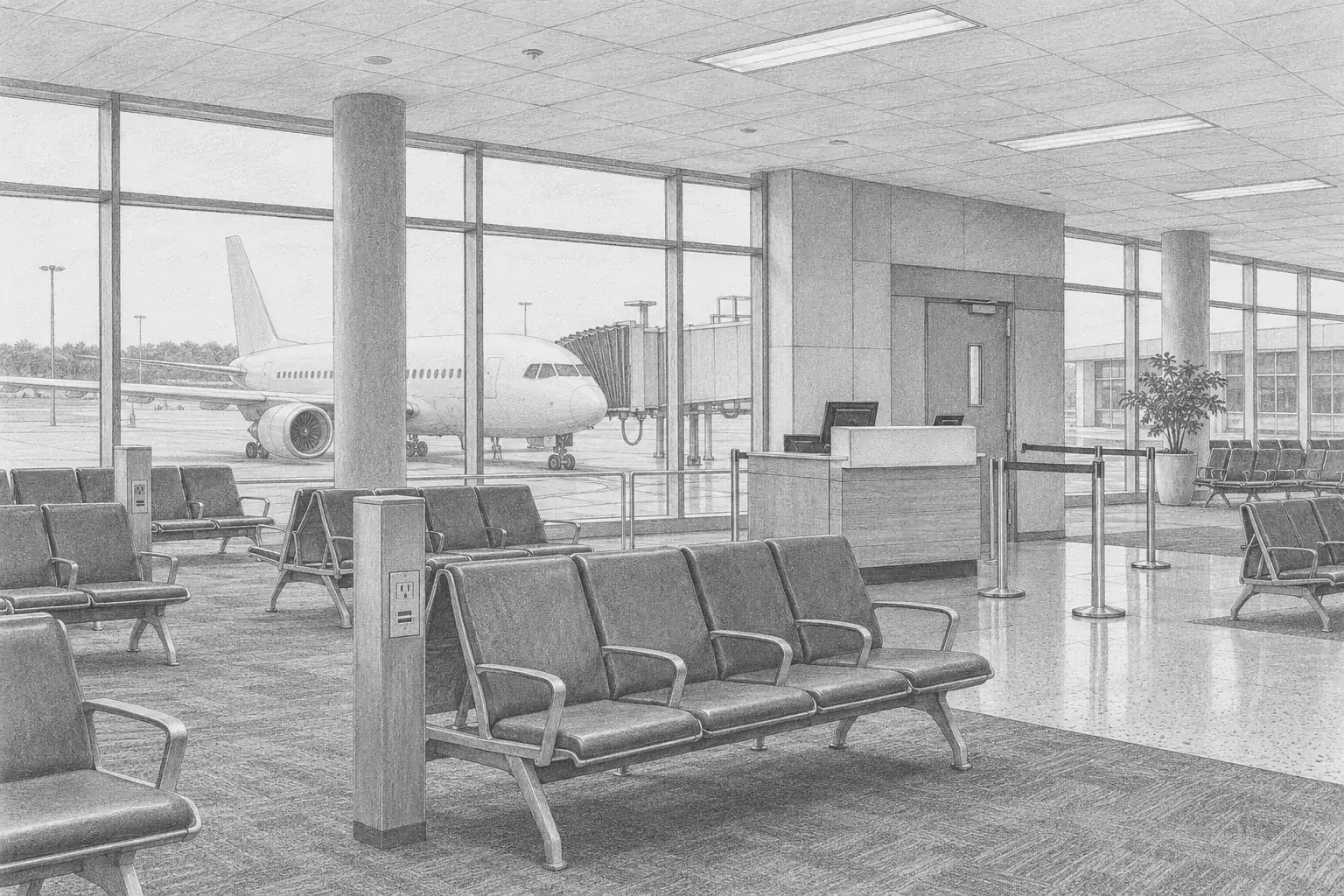
Loom Janitorial cleans airport buildings for the facility and operations managers who keep them running: passenger terminals and concourses, airport administration offices, and the cargo, freight and support buildings around the field. Every part of the work fits inside the airport operator’s security program, which decides who may go where, when, and under whose escort.
Travelers judge an airport by its restrooms, seating and floors, and staff spend whole shifts in its offices and break rooms. Loom runs both on one program, with porters through the busy hours, deeper floor and restroom work when the building is quiet, and one inspection report for the manager.
What an airport cleaning program covers
| Building or area | What Loom cleans | Usual timing |
|---|---|---|
| Concourse and gate restrooms | Fixtures cleaned and disinfected, floors mopped, paper and soap restocked | Porter rounds by day, full clean in the overnight lull |
| Ticketing, baggage claim and seating | Hard floors and carpet, seating, counters, entry glass and trash points | Low-traffic hours |
| Airport administration offices | Desks, conference rooms, break rooms, carpet and hard floors | Evenings or after office hours |
| Cargo and freight buildings | Offices, break rooms, restrooms and dock-side floors | Between shifts |
| Support shops and hangar buildings | Shop floors, locker rooms, crew rooms and waste points | As the shop lead directs |
Carpet in gate areas and offices gets hot-water extraction through our commercial carpet cleaning, and periodic restroom work runs through restroom deep cleaning. Hangars on the field have their own page: aircraft hangar cleaning.
The airport operator draws the lines
Under TSA’s airport security rules (49 CFR part 1542), an airport serving aircraft operators with TSA security programs runs its own security program. That program sets the boundaries of the secured area, the air operations area (AOA), the security identification display area (SIDA) and the sterile area past the checkpoint, so those lines differ from one airport to the next. A tenant can take on security measures in its own leased space under a TSA-approved tenant program, but never for the passenger terminal itself.
Before anyone gets unescorted access to a SIDA, the airport operator must confirm a fingerprint-based criminal history check that discloses no disqualifying offense, and the person must complete security training on badge display, escorting, challenging and their own responsibilities. Inside the secured area or SIDA, an ID is worn on the outermost garment above the waist, or the person is under escort (49 CFR part 1542, as of November 2026). Loom crews are background-checked, and they work under whatever badge, escort or schedule the airport operator sets.
Escorts, doors and each airport’s own rules
Federal rules define an escort as accompanying or monitoring someone without unescorted access while they are in a secured area or SIDA, and only a badge holder with unescorted access may act as one. The escorted person stays close enough that the escort can tell if they stray from the job.
Each airport writes its own rules on top of the federal ones, such as how escort authority is shown on a badge, how closely an escort keeps people in sight, and making sure access-controlled doors close fully behind each pass. The crew learns and follows the rules of the airport where it works.
Keeping terminal trash off the airfield
The FAA’s FOD advisory circular, AC 150/5210-24A (February 2024), is guidance rather than a regulation, and FOD measures sit at the airport operator’s discretion. It builds a FOD program on prevention, detection, removal and evaluation, and says everyone with AOA access should understand their part in prevention, naming cabin cleaning and waste disposal staff and any other contractors.
The circular’s list of typical FOD reads like a trash bin: paper and plastic, soda cans, pens, luggage tags and catering supplies. Wind carries light debris onto the airfield. So on a Loom route liners are tied before they move, carts are covered near any door to the ramp, lids are kept shut, and crews clean as they go through each shift. Where an airport’s rules go further, such as requiring that waste moved within the AOA be secured and covered, those rules lead.
Restrooms, relief areas and accessible routes
Federal ADA rules require public entities and public accommodations to keep accessible features in working order, while allowing brief interruptions for maintenance. In a terminal that means a wet floor, a closed stall or a cart in a corridor should never leave a traveler without a usable route or restroom, so crews work one section at a time.
DOT rules also require airports with 10,000 or more annual enplanements to provide at least one wheelchair-accessible service animal relief area in each terminal, generally past security. Those relief areas go on the restroom route, cleaned and restocked with the rest.
Departure peaks and the overnight lull
Many terminals stay open around the clock, and checkpoints open in the early morning before the first departure. That shapes the day: a day porter keeps restrooms stocked and spills cleared through the departure peaks, and scrubbing, extraction and restroom detail move to the quietest hours.
Offices and cargo buildings follow their own shift times. Our guide to scheduling cleaning in round-the-clock buildings shows how a building that never closes is split into zones with their own visit times.
Request an airport cleaning quote
Tell us which buildings and areas you want covered, the hours each one is busiest, and the access and escort rules your airport applies. Loom is insured and bonded, supervisors carry out quality inspections, and a certificate of insurance comes with every contract. Request a quote to start.
A few useful answers
Common questions
Does Loom arrange airport badges for its cleaners?
The airport operator issues airport ID and decides who receives unescorted access, after its own fingerprint check and security training. Loom crews are background-checked and work under the badge or escort arrangement the airport sets.
Which airport buildings besides the terminal can Loom clean?
Airport administration offices, cargo and freight buildings, support shops and hangar buildings, each with its own task list and visit times.
Why does trash handling matter so much at an airport?
Loose paper, plastic and cans can blow onto the airfield and become foreign object debris. Crews tie off liners, keep lids shut and cover carts near ramp doors.
Can a porter keep concourse restrooms stocked through the morning rush?
Yes. A day porter checks and restocks restrooms and clears spills through the departure peaks, and the full clean happens in the overnight lull.
Can terminal floors be scrubbed without closing a concourse?
Yes. Crews work one section at a time in the quietest hours, so travelers always have an open route past the wet floor.