
Industries
Power Plant Cleaning Services
Janitorial services for the staffed buildings at power plants and utility sites: administration offices, control buildings, plant warehouses and shops, substation control houses and utility service centers, cleaned under the host site’s own safety and access rules.
Janitorial services for generating stations and utility buildings
Loom Janitorial cleans the buildings people work in at power plants and utility sites: administration offices, control buildings, warehouses and maintenance shops, substation control houses, and the service centers and offices a utility runs. Each program reports to the facility, operations, maintenance or EHS manager who answers for those buildings.
The plant sets the rules. The host site decides which rooms a cleaning crew may enter, when, with what protective equipment and under whose escort, and Loom builds the route inside those limits. Energized equipment, boilers, condensers and confined spaces are never on it.
Where a plant cleaning route goes
| Building or room | What Loom cleans | Usual timing |
|---|---|---|
| Administration offices and training rooms | Desks, touchpoints, conference rooms, carpet and hard floors | Evenings or set weekdays |
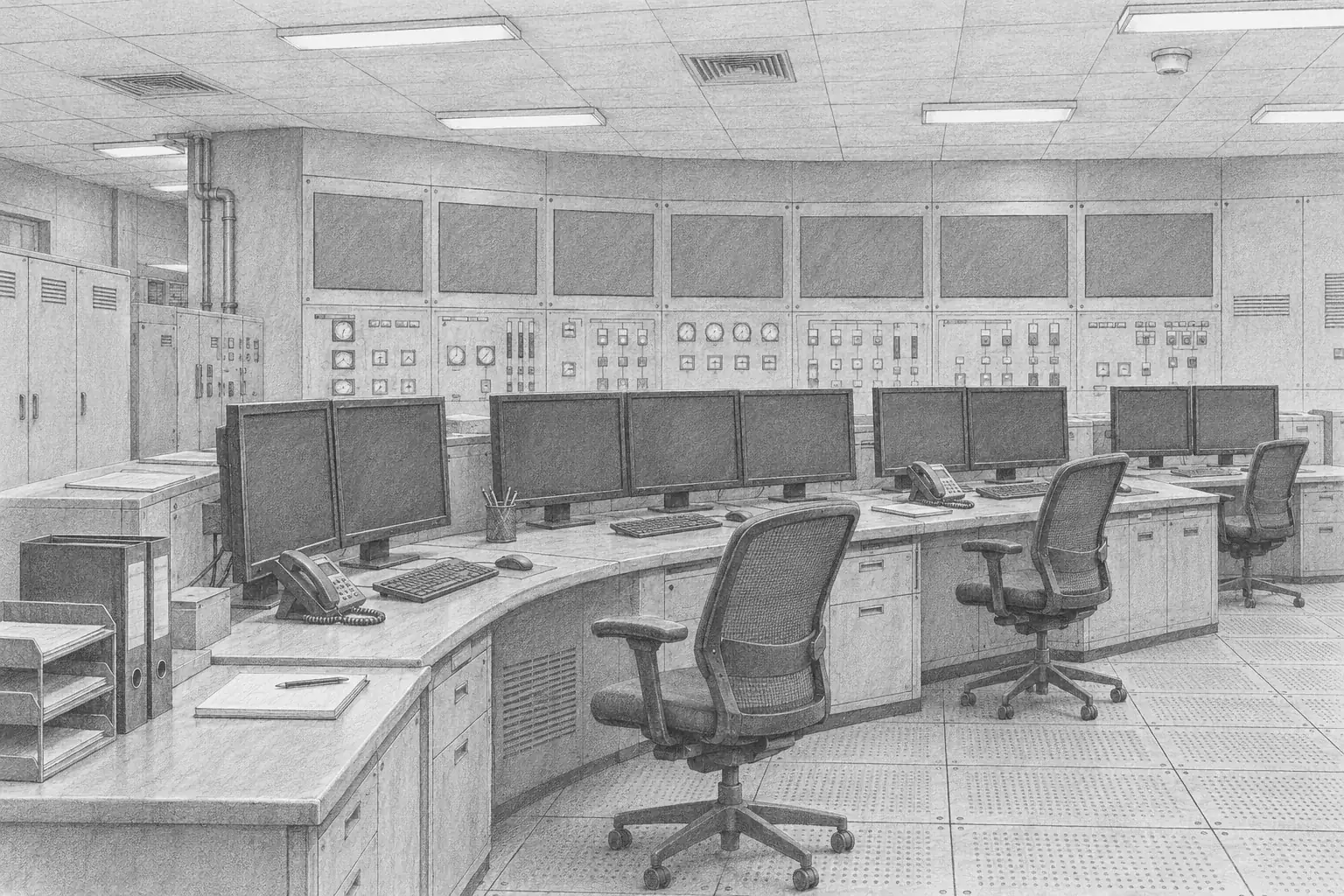
| Control building common areas | Corridors, break rooms, restrooms and floors, as the host allows | Around shift change, as operators direct |
| Plant warehouses and maintenance shops | Floor scrubbing, waste points, high dusting from lifts | Periodic, timed with the shop lead |
| Locker rooms, showers and restrooms | Fixtures, floors, partitions, paper and soap restocked | Every service day |
| Substation control houses | Floors and break areas, entered only when and where the host’s rules allow | On the host’s schedule |
| Utility service centers | Offices, dispatch rooms, crew rooms and shop floors | Nightly or between shifts |
Warehouse floors and overhead dusting use the equipment described on our industrial cleaning page, and shower and locker rooms can add periodic restroom deep cleaning.
Generating and utility sites, offices and control rooms
Crews clean gas, solar, hydro, geothermal and battery sites, substations and service centers, including the offices, control rooms, shops and crew facilities at each.
Hazard information goes both ways
Where OSHA’s power generation standard (29 CFR 1910.269) applies, it calls the plant the host employer and an outside firm the contract employer. The host must tell the contractor about the installation and its known hazards, the contractor passes that to its own people and reports any hazards its work adds, and anything unexpected the contractor finds goes back to the host within 2 working days.
Whichever rules apply to a building, the crew works the same way: the host’s orientation, PPE and access rules come first, the supervisor briefs each crew member on them, and anything odd a cleaner notices is reported to the host contact the same shift.
Energized rooms stay with qualified workers
Under 1910.269, only qualified employees, trained in the equipment and its hazards, may work in areas with unguarded, uninsulated energized parts at 50 volts or more. Rooms holding electric supply equipment must be enclosed or guarded against entry by unqualified people, signed at the entrance, and locked when no one is watching the door. California’s Title 8 High-Voltage Electrical Safety Orders define a qualified electrical worker as someone with at least two years of training and experience on circuits above 600 volts.
Loom’s crews are cleaners, not electrical workers. Switchgear rooms, energized yards and equipment enclosures stay off the cleaning route, and any area like that is entered only under the host’s rules and by the people those rules allow.
Tags, locks and posted spaces
OSHA’s lockout/tagout standard (29 CFR 1910.147) lists cleaning among servicing tasks and says tags are warnings that are never removed without authorization and never bypassed. Workers who are not authorized to lock out are told never to restart locked or tagged equipment, and an on-site employer and an outside contractor must tell each other their lockout procedures. Installations under a utility’s exclusive control follow 1910.269’s own energy control rules instead.
In practice a tagged machine or panel is simply skipped until the host releases it. Permit-required confined spaces, such as tanks, vaults and pits marked with danger signs, are never entered; OSHA requires the host to tell contractors where they are and what precautions apply. In California, Title 8 section 3314 adds that machinery must be stopped and locked out or blocked before it is cleaned, which keeps equipment exteriors in the host’s hands until it is safe.
Escorted visits and sign-in logs
NERC’s CIP-006 physical security standard binds registered utility entities, not cleaning contractors. Where a site’s physical security plan covers a building, anyone without authorized unescorted access must be continuously escorted inside the perimeter, and each visitor’s name, first entry, last exit and escort are logged and kept for at least ninety days.
Crews sign in, wait for the escort and keep to the rooms the host has opened. Because escorted time is the host’s time too, the route groups escorted rooms into one block per visit, the way our data center cleaning handles technical rooms.
California and Nevada coverage
California workplaces fall under Cal/OSHA through the state’s OSHA-approved State Plan. Nevada runs its own State Plan through Nevada OSHA, which has offices in Las Vegas and Reno and has adopted most federal OSHA standards by reference, so Nevada sites work from the federal rules described above.
We clean plant offices, control buildings, shops and utility service centers in Sacramento, Stockton, Fresno, Bakersfield, Redding and Reno, and across the rest of Northern California and Nevada.
Control rooms that never close, and outage windows
A control building is staffed around the clock, so its restrooms, break rooms and corridors are cleaned around shift change, quietly and without crossing the operators’ floor unless the host asks. A day porter can cover restrooms and break rooms through the day for crews on long shifts.
Heavier work waits for the right moment. Warehouse scrubbing and high dusting in shops are booked when the host says the area is clear, often during a planned outage when contractors are already on site. Our guide to cleaning schedules for 24-hour buildings shows how zones get their own visit times.
Request a power plant cleaning quote
Tell us which buildings you want cleaned, the shifts they run, the escort and orientation rules your site applies, and any outage dates ahead. Loom carries insurance, bonding and workers’ compensation, crews are background-checked, and the site receives a certificate of insurance. Request a quote and we will walk the buildings with your EHS or facilities lead.
A few useful answers
Common questions
Which buildings at a power plant does Loom clean?
Administration offices, control building common areas, warehouses and maintenance shops, locker rooms and restrooms, substation control houses where the host allows, and utility service centers.
Are energized equipment rooms part of the cleaning route?
No. Switchgear rooms, energized yards and equipment enclosures stay with the host’s qualified workers and are entered only under the host’s rules.
Can tagged equipment be wiped down?
No. A lockout tag is never removed or worked around, so that surface waits until the host releases the equipment.
How do escort rules change the cleaning schedule?
Escorted rooms are grouped into one block per visit, so the escort’s time is used once and the open areas carry on around it.
Can a control building that runs around the clock stay clean?
Yes. Restrooms, break rooms and corridors are cleaned around shift change, and a day porter can cover them between night visits.